

This week, a viral conversation on the Diary of a CEO Podcast claimed “burnout isn’t real” ” but here’s what caught my attention: the comment section didn’t agree. Thousands of people pushed back, calling it out of touch, unrelatable, evidence of privilege.
The tide is turning. People are done pretending burnout is a personal failing.
And I think it’s time someone named what we’re all starting to see.
Because I’ve been watching a pattern unfold in the online coaching world for years now, and it’s time someone said it out loud.
Scenario
High-achiever leaves their soul-crushing corporate career. They’re done with the politics, the performance reviews, the proving. They’re going to build something different, something aligned, something meaningful, something that actually honours who they are.
Fast forward two years:
They’re posting Stripe screenshots. Celebrating six-figure launches. Showing off the designer handbag they “manifested.” Sharing their morning routine that starts at 5am. Teaching others how to scale, grow, and hustle their way to freedom.
And then, inevitably, a few years later:
“I’ve realised life isn’t all about success and growing your profit each year. It’s actually about living. Being fully present. Slowing down. Aligning my life to my values, not just what’s expected in business.”
Here’s what nobody’s saying: They just burned out again.
They didn’t leave corporate. They rebranded it.
The Pattern We’re Not Talking About
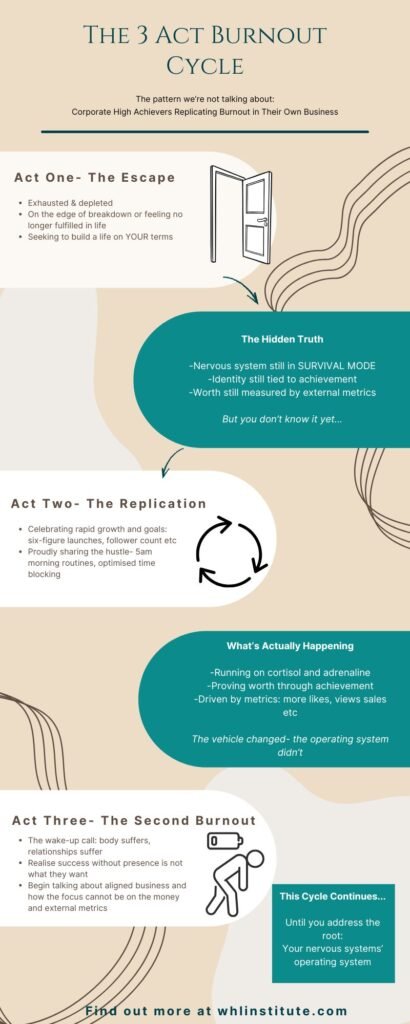
Act One: The Escape
You leave the corporate job that was killing you. You’re exhausted, depleted, maybe even on the edge of a breakdown. You know there has to be another way. Or maybe it’s not at the burnout stage, maybe you’re feeling the pull to a different way of doing life. More freedom, more time.
So you become a coach. A consultant. A healer. You’re going to help others avoid what you went through. You’re going to build a business on your terms.
(Except your nervous system is still in survival mode. Your identity is still tied to achievement. Your worth is still being measured by external validation. But you don’t know that yet.)
Act Two: The Replication
You apply everything you learned in corporate to your coaching business. You set aggressive revenue goals. You launch hard. You scale fast. You celebrate the metrics: email list size, follower count, monthly recurring revenue.
You’re “successful.” People look at you and think you’ve made it. You might even believe it yourself.
But underneath?
You’re still running on adrenaline and cortisol. You’re still proving your worth through achievement. You’re still afraid to stop. You’re still not present for your life.
The vehicle changed. The operating system didn’t.
Act Three: The Second Burnout
Eventually, your body forces the conversation. Or your relationships do. Or the emptiness becomes too loud to ignore.
You realise (again) that this isn’t sustainable (or truly fulfilling). That success without presence is just another form of survival. That you’ve been so busy building the life that you forgot to live it.
So you rebrand. Again. This time to “slow living” or “aligned business” or “sustainable success.” You share vulnerable posts about your burnout. You tell people it’s not about the money.
And you’re not wrong.
But here’s what’s missing: Most people still haven’t done the actual nervous system recalibration.
They’ve changed the messaging. But the survival patterns? Still running.
Why This Keeps Happening: Understanding Your Nervous System’s Operating System
Here’s what most people don’t understand: Burnout isn’t a circumstance problem. It’s a nervous system problem.
And your nervous system doesn’t care if you’re in a corporate cubicle or running a six-figure coaching business from your kitchen table.
It only cares about one thing: Are we safe?
The Survival Blueprint
For most high-achievers, the nervous system learned early on that safety comes through achievement.
Maybe you were praised for good grades but ignored when you struggled. Maybe love felt conditional on performance. Maybe being “the strong one” was the only way to get attention. Maybe chaos at home meant you had to be perfect to feel in control.
Your nervous system absorbed a core belief: Achievement = Safety. Stopping = Danger.
This isn’t conscious. It’s not a thought you think. It’s a pattern encoded in your autonomic nervous system—the part of you that operates below conscious awareness, constantly scanning for threat and safety.
What’s Actually Happening in Your Body
When your nervous system is stuck in survival mode, here’s what’s running underneath everything you do:
Your sympathetic nervous system is chronically activated.
This is your “fight or flight” response. It’s designed for short bursts like to run from the tiger, fight the threat, then return to rest.
But when achievement becomes your safety strategy, your sympathetic nervous system never fully turns off. You’re constantly in a low-grade state of activation:
Cortisol and adrenaline coursing through your system
Heart rate slightly elevated
Breathing shallow
Muscles tense
Digestion compromised
Sleep disrupted
You feel “on” all the time. Vigilant. Ready. Scanning for the next thing to achieve, the next goal to hit, the next way to prove you’re enough.
Your ventral vagal system, your rest, digest, and connect state, is offline.
This is the part of your nervous system that allows you to feel safe, present, connected, and at ease. It’s where creativity lives. Where play happens. Where you can actually be with your life instead of constantly doing.
But when you’re in chronic survival mode, you can’t access this state. Your body literally won’t let you rest because rest feels dangerous.
Your dorsal vagal system kicks in when you’re overwhelmed.
This is your “freeze” or “shutdown” response. When the sympathetic activation becomes too much, your nervous system pulls the emergency brake.
This is when you feel:
Numb
Disconnected
Exhausted but can’t rest
Like you’re watching your life from the outside
Hopeless or empty
Many high-achievers cycle between sympathetic activation (pushing, achieving, doing) and dorsal shutdown (collapsing, numbing, disconnecting). They never land in the middle, in ventral vagal safety, where actual presence and wholeness live.

Why Leaving Corporate Doesn’t Fix It
Here’s the part that breaks my heart:
You think if you just change the circumstances, you’ll feel different.
“If I leave this job, I’ll be free.” “If I work for myself, I’ll have control.” “If I hit this revenue goal, I’ll feel secure.”
But your nervous system doesn’t work that way.
Your nervous system doesn’t respond to logic. It responds to felt safety.
And if your nervous system learned that achievement = safety, it will continue to drive you toward achievement, no matter what your circumstances look like.
The Replication Happens Automatically
This is why coaches who leave corporate burnout end up burning out again in their own businesses:
The survival strategies that kept you “safe” in corporate are still running.
You’re still:
Overperforming to prove your worth
People-pleasing to avoid conflict or rejection
Perfecting everything to maintain control
Pushing through exhaustion to stay “safe”
Achieving to feel valuable
The only difference? Now you’re doing it with:
Better branding
More inspirational language
Prettier Instagram aesthetics
“Aligned” messaging
But underneath, your nervous system is running the exact same program.
You’re still in sympathetic activation, just with a different job title.
The cortisol is still there. The shallow breathing is still there. The inability to rest is still there. The fear of stopping is still there.
You’ve changed the vehicle. But the operating system? Identical.

The Uncomfortable Truth the Coaching Industry Doesn’t Want to Hear
You can’t mindset your way out of survival mode.
You can’t affirmation your way into nervous system regulation.
You can’t “manifest” your way out of trauma responses.
The coaching industry loves to sell the idea that changing your thoughts changes your life. And yes, mindset matters.
But if your body is still in survival mode, if your nervous system is still running on cortisol and adrenaline, still scanning for threat, still equating achievement with safety, your thoughts are just a prettier version of the same operating system.
You can tell yourself “I’m worthy” all day long.
But if your nervous system doesn’t feel safe unless you’re achieving, you’ll keep achieving. Even when it’s killing you.
Why “Self-Care” Isn’t Enough
This is also why the typical “self-care” advice falls flat for high-achievers.
“Just take a bath.” “Try meditation.” “Set boundaries.” “Work less.”
These aren’t bad suggestions. But they’re surface-level interventions for a deep nervous system problem.
If your nervous system is in survival mode, a bath isn’t going to recalibrate it. Your body will be in the bath, but your mind will be planning the next launch, rehearsing the next conversation, worrying about the next metric.
Because your nervous system doesn’t believe it’s safe to stop.
What Actual Nervous System Recalibration Looks Like
Real recalibration isn’t about working less. It’s about working differently, from a place of wholeness, not survival.
It requires addressing the survival patterns at the level they were encoded: in your body, not just your mind.
1. Building Felt Safety in Your Nervous System
This is the foundation. Your nervous system needs to learn, through repeated experience, not intellectual understanding, that you are safe even when you’re not achieving.
This happens through:
Somatic practices: Breathwork, gentle movement, safe touch, grounding techniques that signal safety to your body
Co-regulation: Being in the presence of someone whose nervous system is regulated (this is why good coaching or therapy matters)
Titration: Small, manageable doses of rest and presence, gradually building your capacity to tolerate not-doing
You can’t think your way into felt safety. You have to experience it, again and again, until your nervous system updates its threat assessment.
2. Identifying Your Survival Strategies
You need to become aware of how your specific nervous system learned to stay “safe.”
For some, it’s overperforming. For others, it’s people-pleasing. For many, it’s perfectionism or control.
These aren’t character flaws. They’re adaptive strategies your nervous system developed to navigate an environment that didn’t feel safe.
But what kept you safe as a child or in corporate will keep you stuck in survival as an adult.
The work is to recognise these patterns with compassion, understand their origin, and consciously choose different responses.
3. Rewiring the Achievement = Safety Equation
This is identity-level work.
Your nervous system needs to learn a new equation: I am safe because I exist. Not because I achieve.
This doesn’t happen through affirmations. It happens through:
Embodied practices that help you feel your inherent worth in your body
Nervous system regulation that allows you to access rest without threat
Boundary work that teaches your system you can say no and still be safe
Compassionate inquiry that helps you understand the roots of your patterns
This is slow work. It’s not a 30-day challenge or a weekend workshop. It’s a recalibration of your entire operating system.
4. Building Capacity for Presence
The goal isn’t to stop achieving. It’s to be able to achieve and be present. To work and rest. To succeed and feel alive.
This requires building your capacity to tolerate the ventral vagal state- the state of safety, connection, and presence.
For many high-achievers, this state feels uncomfortable at first. Boring, even. Because your nervous system is so used to the activation of doing.
But this is where life actually happens. Not in the next achievement. Right here. Right now.
The Real Work
The real recalibration isn’t about:
Working harder
Optimising more
Proving you’re disciplined enough
Hustling your way to worthiness
It’s about understanding that your nervous system learned to equate achievement with safety.
And until you address that at the somatic level in your body, not just your mind, you’ll keep replicating the same patterns in different packaging.
This isn’t about working less. It’s about working differently. From a place of wholeness, not survival.
If you’ve left corporate only to find yourself burned out again in your own business, you’re not broken. You’re not undisciplined. You’re not lacking drive.
You’re just still running the same operating system.
And the good news? That can change. But it requires more than a rebrand. It requires actual nervous system recalibration.
The kind that happens in your body, not just your Instagram captions.
The kind that allows you to be ambitious and whole.
The kind that lets you build something meaningful without sacrificing yourself in the process.
The conversation is shifting. People are ready to hear this.
The backlash to “burnout isn’t real” proves it.
The question is: Are you ready to do the actual work? Let me know what resonates for you in the comments.
💛 Debs
Ready to Break the Cycle?
If this pattern feels painfully familiar, if you’ve recognised yourself somewhere in these three acts, I want you to know: there is another way.
Real recalibration is possible. But it doesn’t happen through another course, another framework, or another rebrand.
It happens through deep, embodied, trauma-informed work that addresses your nervous system at the root level.
This is the work I do in my Bespoke 1:1 Recalibration Mentorship.
Over 12 months, we work together to:
Identify and understand your specific survival patterns
Build felt safety in your nervous system through somatic and shamanic practices
Rewire the achievement = safety equation at an identity level
Develop your capacity to be present, not just productive
Create a life and business that honours your wholeness, not just your worth
This isn’t group coaching. It isn’t a one-size-fits-all program. It’s bespoke, deeply personalised work, because your nervous system’s story is unique to you.
Learn more about Recalibration Mentorship →
Or, if you’re not sure you’re ready for that level of commitment yet, I invite you to start here:
Listen to the WholeHearted Living Podcast: Episode 1 – “You Are Wholeness: Returning to the Ground Beneath All Growth”
This episode is the foundation of everything we’ve explored in this article. It’s where I introduce the concept of wholeness as your natural state, the ground beneath all the survival patterns, all the proving, all the achievement.
You can listen on Apple Podcasts | Spotify | YouTube
And if you want to go deeper, download the free Rooted in Wholeness Companion Guide- it includes journal prompts, somatic practices, and integration tools for every episode.